Designing Data Centers: Integrating Structural Engineering for Optimal Performance
By Daryl Barone, P.E., S.E., Associate, S. A. Miro, Inc.
Many design elements must be considered when enclosing data centers’ computational systems. Some of the more popular and obvious factors include the power capabilities and internal environment. It is well known that data centers require tremendous power, so of course that needs to be addressed. It is also known that proper temperature and humidity controls are critical for data centers to run at an optimum level. However, there is another area of engineering that must be consulted for a data center to be safe and effective – structural engineering. Many may not realize it, but structural engineering plays a critical role in ensuring an uninterrupted operation.
On the surface, a data center may appear to simply be the plain box within which the real work is accomplished. However, there’s more to the structural needs of a data center than meets the eye. As previously mentioned, the power, cooling and computing systems of these facilities are crucial. Thus, the primary goal for structural consultants of mission-critical partners and clients is to support these key functions in a smooth, uninterrupted, and cost-effective manner. The most optimal approach is to have open communication between all interested parties during the planning stage of the structure. It’s during this early stage that all the structural considerations should be outlined and budgeted. These include floor loading and site utilization, wind and seismic force resistance, building expansion/contraction, cooling system accommodation, sound attenuation and underground utility coordination.
Floor Loading and Site Utilization
Traditional commercial and storage facilities are typically designed for live loading of 100 to 150 pounds per square foot (psf). However, data centers have greater load requirements. The racking systems for data centers typically generate loads of 400 psf. Traditionally, the slabs on grade in one-story buildings possess ample capacity to support loads of this magnitude. However, in recent years, the desire to maximize available real estate has led to more two-and three-story facilities. With these kinds of buildings, significant floor structure is required to support elevated racks, along with the necessary associated mechanical, electrical and plumbing (MEP) systems. This leads to story heights in excess of 30 feet and overall building elevations as high as 90 feet above the surrounding grade. Additionally, to further maximize space, the supporting backup power generation systems are often stacked. This rivals the height of the building footprint.
Resistance to Wind and Seismic Forces
 Although not a requirement, maintaining 24/7 operational capability calls for a Risk Category of IV (as opposed to Category II for typical commercial buildings) to be applied in the design of the data center, support building structures, as well as the support and attachment of MEP elements. This results in design loads for wind and earthquakes increased by roughly 50 percent.
Depending on the number of pods to be incorporated, data centers tend to be organized in a rectangular footprint. This includes a narrow dimension of slightly more than 200 feet and a length of roughly 1000 feet in a single-story and 650 feet in a two-or three-story configuration. For multiple stories, not only are wind forces obviously increased, but the seismic effects are also greatly magnified. The elevated racks increase the seismic response of the structure.
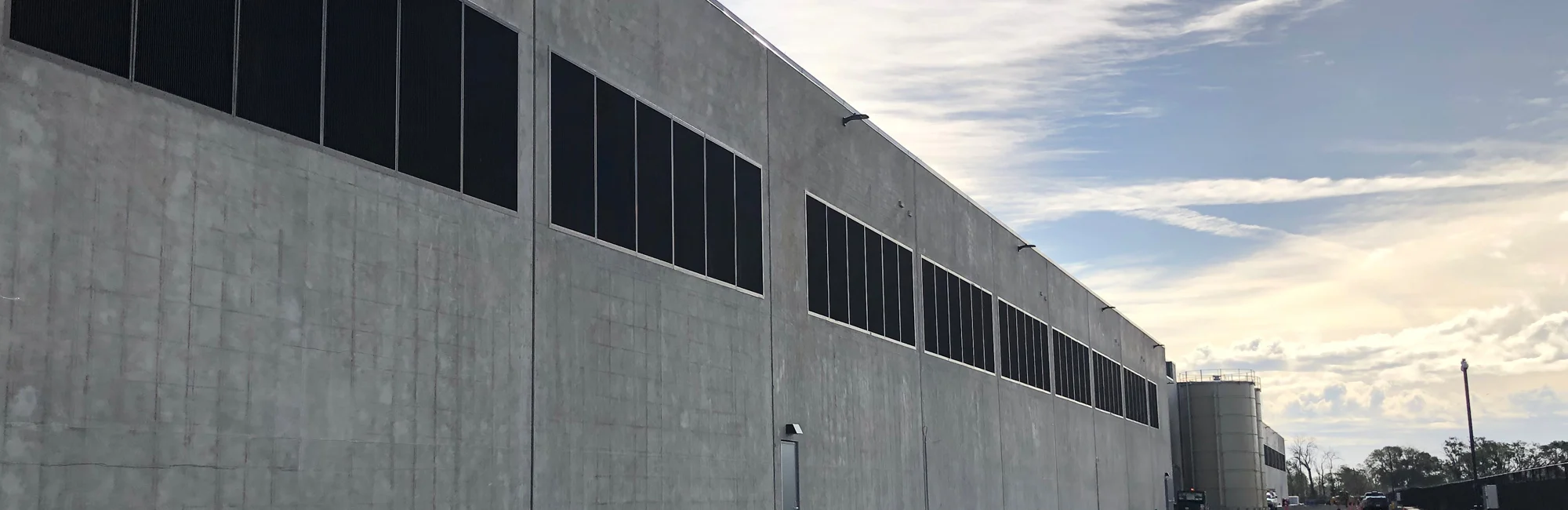
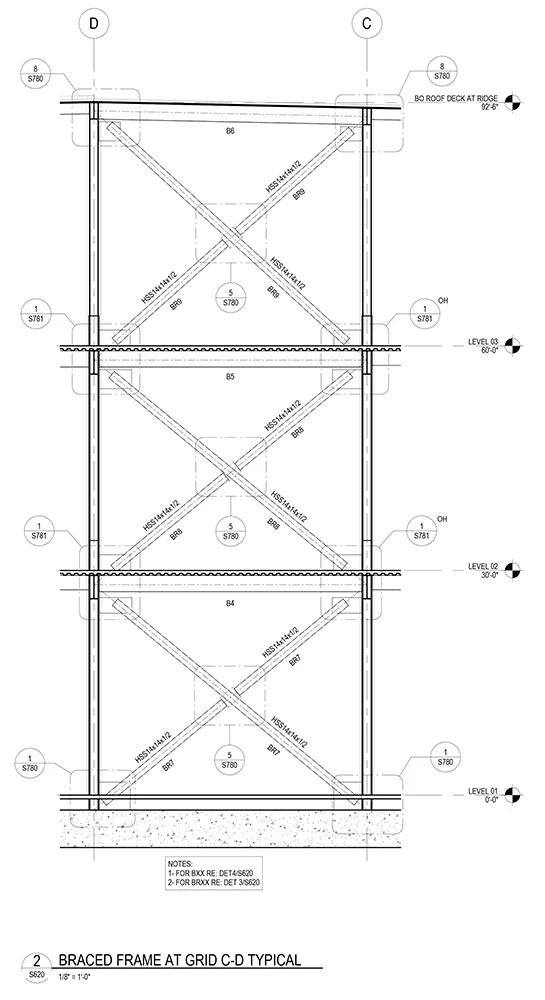
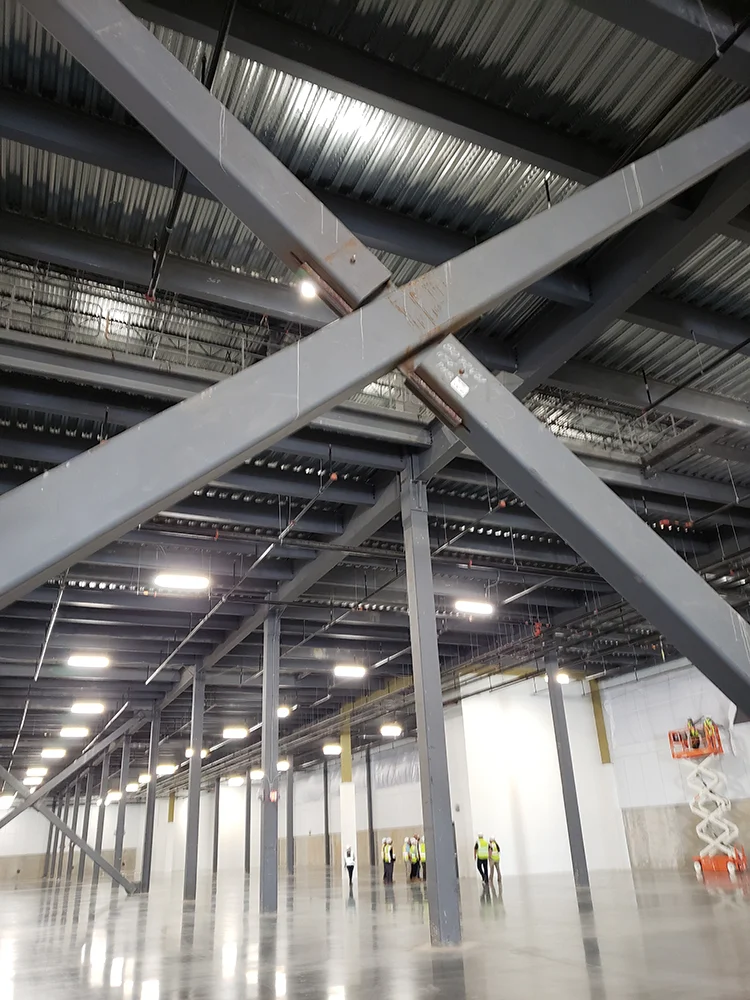
Steel braced frames (Figure 1) and concrete shear walls are both commonly used methods of resisting lateral forces. Both are designed to transmit forces applied to a building roof and walls to its foundation. Brace elements are placed within, or adjacent to, exterior walls, as the cooling demands often require 25 percent of the total wall area to be open for heat exchange equipment. Additionally, the size and shape of data halls typically require intermediate braces to be included every 100 feet, parallel to the narrow building direction. These locations and widths should be confirmed and accounted for in the layout of hot and cold aisles. This will avoid conflicts with both the racks and the power and cooling supply lines.
For data centers requiring expansion joints due to thermal expansion and contraction, great care must be taken in coordinating the drifts of the building on each side of the expansion joint due to wind and seismic loads. Any MEP components crossing over the joints require flexible connections and fittings that allow for movement in all plan directions, and the limitations of these fittings can sometimes control the allowable drift of the building more than what is allowed by code. Additionally, the Architectural cover plate assemblies for the expansion joints have loading and width limitations that need to be considered as well.
Building Expansion and Contraction
 To accommodate the effects of seasonal temperature change without causing structural/architectural damage, buildings measuring more than 500 feet in length or width generally require an intermediate expansion joint at or near their mid-length. This allows for independent movement of each segment of the structure. A single-story data hall often includes two joints across its narrow dimension, with the joint width ranging from 2 to 8 inches. Larger joint widths are required in regions of higher seismic activity. This prevents the building segments from colliding as they move in response to the supporting soil during seismic events.
Redundant structure (a row of columns and beams on each side of the joint) is a reliable means of allowing unrestricted movement between segments and is essential in the initial planning of single-story facilities.
To maintain facility operation, any systems or building finishes (piping, conduit, drywall) extending across an expansion joint must accommodate the same degree of movement as the structure itself.
For these reasons, it is worth considering early on in the project design if it is possible and beneficial to eliminate the expansion joint by designing the structure for the thermal loads imposed.
Cooling and Exhaust Systems
Data centers require significant power, and this need is only growing with the advent of machine learning (AI). Mechanical and electrical engineers are continually working with owners to implement systems that use less energy to remove or recirculate the heat expended by server racks. Sometimes, these systems include air-cooled chillers on standalone platform structures next to the data hall and exhaust systems mounted on rooftops. With either approach, the weight of the units can reach tens of thousands of pounds. With numbers this large, their support framing must be accounted for in the initial budget. The scale of thermal exchange required makes the liquid-carrying piping to be heavier than the traditional heat exchange infrastructure used in commercial and manufacturing operations.
Sound attenuation
Data centers need to be located near sources of primary power, which is why they are often situated close to population centers. In addition to the design considerations to mitigate the building’s visual scale, local jurisdictions also often require that the sound from backup power generators be masked. Often, free standing acoustical screen walls are required around the generator yard, or elsewhere on site. These can range from 30 feet to 50 feet in height, which makes them significant structures, requiring both site area and inclusion in the project budget. Additionally, acoustical screen walls on the roof of the data center are sometimes required. This significantly increases the wind exposure on the building and must be considered in both the gravity and lateral design of the building.
Underground utility coordination
In construction, a shallow foundation system consisting of spread footings or mats offers an economical solution compared to drilled piers or piles. Where soil conditions permit, shallow foundations are generally used, with multi-story buildings requiring ground improvement methods via rammed aggregate piers or rigid inclusions. However, these elements can boast widths of more than 10 feet, or double that for braced frame foundations, and extend the length of each lateral brace. This elevates the need for proper coordination with the project’s mechanical, electrical, and civil consultants, so piping and conduit can be effectively routed around or above all foundations (rather than through or under).
This is just a snapshot of the considerations that owners, developers, and design professionals should take into account when planning new data centers or adapting existing buildings for this purpose. Early incorporation of the geometric and cost implications of these considerations will help facilitate the efficient installation of all building systems and support the data center’s operational mission.
about the author

Daryl Barone, P.E., S.E.
Published in the 7×24 Exchange 2025 Spring Magazine
Daryl Barone is an Associate at S. A. Miro, Inc.