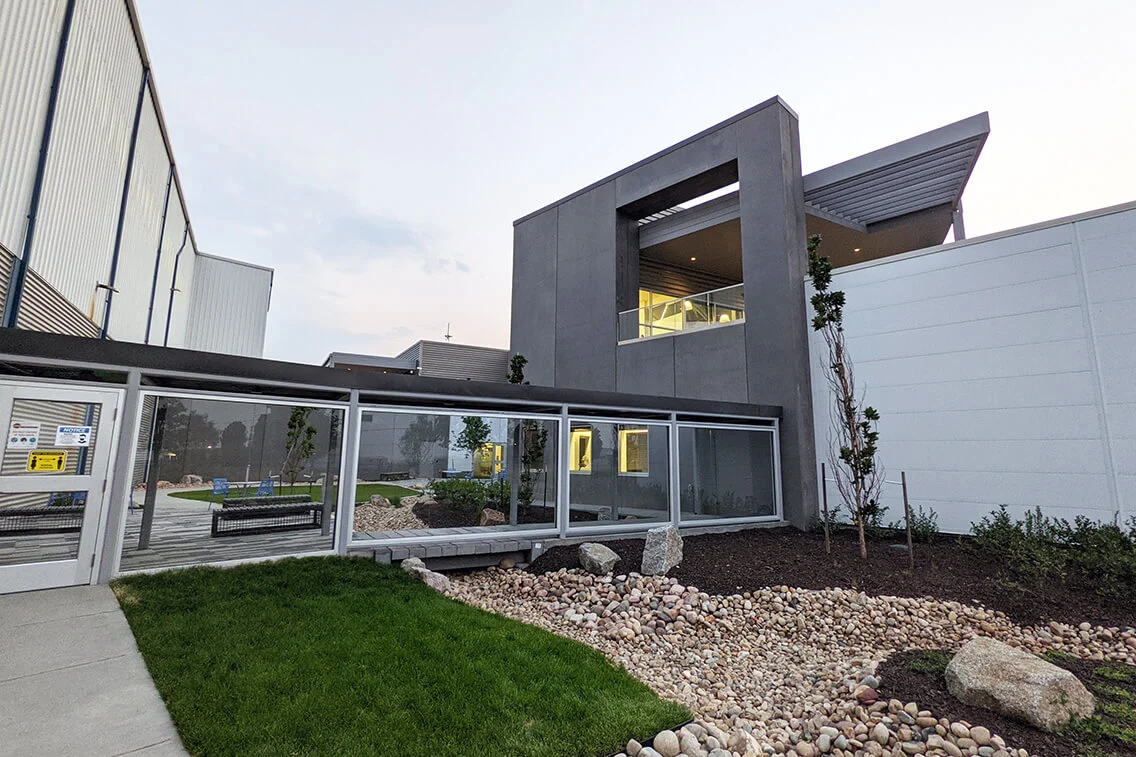
In its place, we supported the design and development of a 40,000 SF, two-story facility that accommodated office, laboratory, and warehouse functions. Temporary facilities were used to house staff during construction, and we coordinated utility considerations to support these interim operations.
Our civil design approach maintained much of the existing site infrastructure, including access points, drive lanes, and parking areas, while addressing known drainage challenges by improving low-lying areas where stormwater had accumulated. We also evaluated modifications to the building entrance, including the design of a new drop-off area and entry plaza to enhance site circulation and user experience.
From a utility standpoint, we worked closely with the owner, water district, and MEP team to consolidate existing water services and meters into a single, efficient system, without the need for new public water mains. Existing sanitary sewer services were reused, and no new public sanitary infrastructure was required.
Stormwater management leveraged the existing detention pond located at the northeast corner of the site, which provided adequate capacity for the proposed development. While sustainable design strategies were incorporated into the project, formal certification programs such as LEED were not pursued.
From a structural perspective, we led the engineering design of the new facility, replacing the existing 15,600 SF structure. Our design supported a flexible mix of office, laboratory, and warehouse spaces, ensuring both efficiency and adaptability for operational needs.
In addition, our scope included minor interior structural modifications to the existing hangars to support their continued use and integration with the new building. Through our coordinated civil and structural design efforts, we delivered a cohesive solution that modernized the facility, enhanced site performance, and supported the long-term mission of University Corporation for Atmospheric Research.